Monday, April 14, 2008

An amazing book, 2

Another unofficial screen capture from the Census Atlas of the United States. The red arrow shows migration to California between 1955 and 1960. The blue arrows show the reverse trend between 1995 and 2000.

Everyone who lives in Washington knows that a lot of Calfornians moved up here in the late 1990s (60,000+). But how many know that 40,000 Washingtonians headed to the Golden State in the late fifties? I sure didn't.

An amazing book

Our library just received its federal depository copy of the Census Atlas of the United States. It is just a wonderful piece of work. You can see it on the web but I respectfully suggest you find a library that has the hardcover. That way you can stick your nose down into the details.

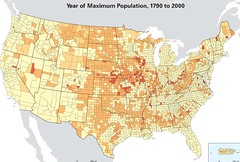
I'll put up a few unofficlal screen captures for your enlightenment. See this one? It shows the (census) year of maximum population for each county in the United States. The brightest yellow means the highest number is 2000 - the county is bigger now than it has ever been. That's true of my home, for example.

But the darkest colors are reserved for counties that reached their pop peak BEFORE 1860. Wow.

Tuesday, April 8, 2008

Encyclopedia of Earth


EARTH
Originally uploaded by miqul

This is pretty cool. The Encyclopedia of Earth wants to be the largest reliable source on environmental issues. It is free, online, and sort of a controlled Wiki. Approved authors can change each others' work but there are assigned editors, and nothing is done anonymously.

They borrow (with permission) articles from government agencies and other reliable sources. So, for example, the article on Rachel Carson comes from the US Fish and Wildlife Service (her former employer) but there is a separate article on her environmental ethics written for the Encyclopedia by a philosophy professor in Colorado. (There is a brief bio of each author, so you can judge their reliability.) This is followed by a dozen other articles that mention Carson.

Very nice work. We could use a hundred more in different fields.

Wednesday, April 2, 2008

Historians Heart Librarians


Heart shaped book
Originally uploaded by Trash Queen
My favorite history blogger is Ed Darrell of Millard Fillmore's Bathtub.
Recently he wrote a little piece in praise of librarians and gave a long list of librarian blogs with interesting names. A subset lies below. (I repeat his warning that they haven't been checked to see if they are safe for work viewing.)
(Not So) Bad Girl Librarian
Library Snark
Love the Liberry
Miss Information
Naked in the Public Library
Tiny Little Librarian
Vampire Librarian

Tuesday, April 1, 2008

About a theft


Vandalized book
Originally uploaded by fifteeniguana
Here's the nutshell. Someone stole a lot of maps and similar pages from the library where I work. A lot of people at the university helped catch the alleged thief. You can see the whole story at my other blog, Criminal Brief.

Monday, March 24, 2008

Labor history online


On strike
Originally uploaded by louder
Something cool from the US Department of Labor: the Wirtz Labor Digital Library. A few titles that popped up on a casual browse:

If Your Baby Must Travel In Wartime - a guide for mothers traveling (mostly by train) during World War II. Illustrations by the brilliant Gluyas Williams make it more interesting.

A History of Organized Felony and Folly: The Record of Union Labor in Crime and Economics. A 1923 guide by the Wall Street Journal of all the crimes of organized labor. Interestingly enough the only source in the digital library that mentions Clarence Darrow.

Boy Power - The newspaper of the U.S. Boys Working Reserve, which I had never heard of, but was apparently a government program during WWI to steer youngsters into useful occupations.

The Potter and Lead Poisoning - A nineteenth century Biritsh government document about an industrial hazard.

There are 18 documents about black lung. None about Wobblies., but "IWW" brings up three editions of Important events in US Labor History.

Tuesday, March 18, 2008

Before New York, New York

Next year marks the 400th anniversary of Henry Hudson's visit to the island of Mannahatta, now known as Manhattan. Eric Sanderson, a landscape ecologist, has created a map of the island as it would have looked back then. You can read about it and see pictures in the New Yorker
Thanks to My Green Element for pointing it out.