Showing posts with label History. Show all posts

Wednesday, May 18, 2011

How Overdue Books Caused The Civil War

That's the title of my article, just published at the American Libraries magazine website.  It is a true story of the House of Representatives, the New York Times, the Dred Scott Decision... and overdue library books.

Thursday, February 10, 2011

Enemy Combatants: Black Soldiers in Confederate Prisons


The latest issue of Army History magazine (D 114.20:78) has a wonderful article by Thomas J. Ward, Jr.

When African-American Union soldiers were captured in the south the Confederacy had no idea what to do with them. The one thing they were clear on was that they couldn't treat them as Prisoners of War.

Some were summarily executed. Some were judged to be slaves and returned to their masters. Some were made to work for the Confederate army at the front lines (until Union General Benjamin Butler put white Confederate prisoners in the same position.)

Some free blacks were turned over to civilian courts to be tried but this proved an embaressment when the court ruled that it had no jurisdiction over crimes committed by men acting as soldiers.

Later in the war some of them were treated as POWs but the Confederacy refused to swap them for southern prisoners - which would imply that white and black were equal.

Fascinating story...

Monday, April 12, 2010

Ancient History


Okay, this cracked me up, even though the main part of the story was tragic....

Most mornings, when I'm checking my email before work, I listen to WUMB, the Boston radio station that plays only folk music. Every morning Dave Palmater announces events from music history that happened on this date. Inevitably, most of them are about rock.

Today he made an announcement that went something like this: "On this day in 1966 Jan Berry of Jan and Dean was almost killed in a car accident near Dead Man's Curve."

There was a pause as he thought about what to say next. Then:

"I'm not going to explain it. If you're under fifty, don't worry about it. It's not important."

Little things amuse little minds.

Friday, February 26, 2010

Periods of War


Occasionally we get questions about the dates the U.S. was officially at war with some other country. Here is a nice, authoritative source. The Congressional Research Service has published a list of official periods starting with the Indian Wars (January 1, 1817, through December 31, 1898) and continuing up to the wars that haven’t ended.

The main purpose is to help determine whether someone is eligible for veteran’s benefits, but students have asked for these dates as well.


Monday, February 15, 2010

My part in history


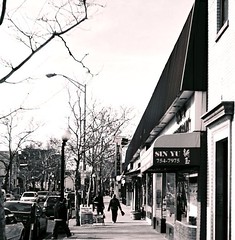
Park Avenue
Originally uploaded by DaCosta1
It's a strange thing to read about a historical movement or moment and realize that you, unwittingly, were part of it.

Years ago I read a piece by a fellow government information librarian about an older man coming into the library looking for tax forms. When he discovered he was in a depository for federal documents he asked if they had any publications about the Korean War. He had fought there and had always remembered one battle he and his comrades had marched to, fought at, and those who survived marched away from. Life went on, and no one ever told them the point of that fight or even who had won. He was thrilled to find a Defense Department book that told him what his part in the War had been about.

My tale is not so dramatic, fortunately.

I am working on a short story about the riots that hit Plainfield, NJ during the long hot summer of 1967. They effected my family in several ways. But in researching that event I came across an earlier one.

My first years of education were spent at Cedarbrook School, which was all White. In sixth grade I was moved to Washington School which was closer to home and had both Black and White students. The next year I moved to a junior high. I always thought it was weird that Plainfield had a special school for sixth graders, but never thought much more than that.

In one of the articles I read I learned that Plainfield fully integrated its schools in 1967 but two years earlier they had acquiesed to complaints by integrating Washington School, which had been all-Black even though it was close to some White eighborhoods.

It turned out I was part of the school integration movement. Nobody ever mentioned it to me - as far as I recall.

So what do I remember from Washington School? Two great teachers, Mr. Charloff and Mrs. Sonin. One new friend, Craig Sweet. And life went on...

Photo of Park Avenue in Plainfield by DaCosta1

Thursday, September 25, 2008

The Other Other George Bush


bush4
Originally uploaded by fifteeniguana
Take a look at the document on the right. The man's name is an attention-getter, but it's really a distraction.

The important question is why did it require a private act of Congress to permit George W. (for Washington, not Walker) Bush to own the land he had been farming for ten years? Everyone agreed that he was one of the most important pioneers in the northwest, so why couldn't he claim and own a piece of land like every other settler did?

The answer: because he was a Mulatto, and African-Americans were not permitted to own land in Washington Territory.

This gentleman was arguably more interesting than the various other George Bushes that have come along since. A successful merchant, Bush subsidized other members of the wagon train that he and his family used to cross the Oregon Trail. Some of the settlers chose to defy the Hudson Bay Company and become the first Americans to settle north of the Columbia River, because Bush could not live in Oregon (to keep slavery out, they had banned all Blacks). When the first winter hit Bush was one of the very few farmers with crops in the ground and he shared them with his neighbors when he could have made a profit instead.

I remember reading a discussion of Bush's birth year and one historian said, approximately, that of the several possible he was choosing the least likely because, in the case of this man, the least likely usually turned out to be correct.

Why hasn't Hollywood made a movie about this guy?

You can see the full text of the committee report (2 pages) here and here.

Wednesday, April 2, 2008

Historians Heart Librarians


Heart shaped book
Originally uploaded by Trash Queen
My favorite history blogger is Ed Darrell of Millard Fillmore's Bathtub.
Recently he wrote a little piece in praise of librarians and gave a long list of librarian blogs with interesting names. A subset lies below. (I repeat his warning that they haven't been checked to see if they are safe for work viewing.)
(Not So) Bad Girl Librarian
Library Snark
Love the Liberry
Miss Information
Naked in the Public Library
Tiny Little Librarian
Vampire Librarian

Friday, September 7, 2007

An Encounter With Mr. Browne


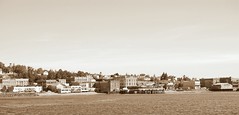
Port Townsend
Originally uploaded by onepurplefork
While working with our hundreds of volumes of the Congressional Serial Set I met an old friend today. Volume 1342 of the Serial Set is a report on the mineral resources of the west written by J. Ross Browne.

Browne, an Irish-born gentleman, may be unique in world history. He is the only person I know who made a living by writing 1) government reports and 2) humor.

I know. As a combination it doesn't flow like cup and saucer, does it?

Here is Mr. Browne describing part of our state in his best officialese:

Port Townsend, on the bay of that name, is the county seat. It is the site of the customs-house of Puget Sound; the marine hospital is located here, and at the head of the bay is the military post, (Fort Townsend). The bay is six miles long, four wide, and an excellent harbor.

DId you stay awake through all that? Good for you. Now here is the same Mr. Browne (slightly edited by historian Murray Morgan) writing in one of his unofficial books:

Port Townsend is indeed a remarkable place. The houses, of which there must be at least twenty in the city and suburbs, are built chiefly of pine boards, thatched with shingles, canvas and wood slabs. The streets of Port Townsend are paved with sand, and the public squares are curiously ornamented with dead horses and the bones of many dead cows.

This of course gives a very original appearance to the public pleasure grounds and enables strangers to know when they arrive in the city, by reason of the peculiar odor, so that, even admitting the absence of lamps, no person can fail to recognize Port Townsend in the darkest night.

Oddly enough, the citizens of Port Townsend were not appreciative of Browne’s attentions. But it can be argued that one result of his scandalous description was that when a gold rush hit the Pacific Northwest the only town in the area that every miner knew of – and flocked to – was the wicked city of Port Townsend. Proving, I suppose, that there’s no such thing as bad publicity.