Saturday, August 16, 2008

Ramat Rachel 12 - Soldiers in sequins


Ramat Rachel glass
Originally uploaded by fifteeniguana

This is my last entry about volunteering at an archaeological dig in Israel. If you have just arrived, please start at the first entry.
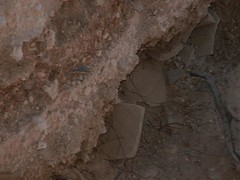
By the way, the photo shows the only piece of glass I found. See the rim? Probably from a glass or bottle from the early Muslim era. Not much, but I liked it.

A few final questions…

What has changed since you were last in Israel in 1997?
The Old City in Jerusalem is a lot scarier than it used to be. I talked to some people who visit the country more often than us and they agreed. More crime, more crowds, more bad manners, and a lot more security.

I also noticed a lot more influence of people from the former Soviet Union than last time I was here. Russian language TV, some store names in Cyrilic.

In 1997 I was astonished by the number of soldiers wandering around with what I took to be semi-automatic machine guns. This time I also saw a few people in civilian clothes carrying them, and a few more with holstered pistols. (One of my fellow volunteers, an American nurse, was thrilled to pieces that the tractor driver who attacked traffic on the day Obama arrived was shot dead by a civilian. She’s a big fan of Bernie Goetz, if you remember him.)

I also saw a lot of soldiers in what you might call partial uniform. One was dressed in fatigues and carrying a white sequined purse (yes, it was a woman). I could imagine a US marine drill sergeant seeing her and having a coronary on the spot.

Can you define the archaeological experience in one word?

Dirty. Let’s not neglect the obvious: you are digging, scraping, loading, transporting, and generally messing around with dirt. We had to shower, shampoo, repeat, and use conditioner, after every days work. I wore brand new sneakers and one shoe lace broke from the sheer strain of being pulled tight with so much sand in it..

Whenever we heard that a photographer was coming to immortalize our site we stopped digging and spent up to half an hour sweeping away at the walls and surfaces with a brush. This is not silly: people will be studying the photos for years so you want the details to show as clearly as possible.

On the other hand, (surprise!) the photos with people in them were staged. The most attractive young people were sent down again and again to have their picture taken. That was silly. Not that I volunteered to pose, by the way. I loved it when Oded tolk Konni to “look like you’re brushing, but don’t brush.”

By the way, our friend Evelyn urged us to buy some of the new nylon hiking clothes and she was right on the money. They were loose, cool, and wore like iron. Terri and I each wore the same pants for ten days of crawling over, under and through dirt, stones and dust. Thedy didn’t develop a tear or even a stain. Wash them out in the sink, hang ‘em up in the tub and in the morning they are ready to play again.
Kneepads came in very handy too, although I didn't spend a lot of time on my knees, per se. They were great for leaning against rocks and for crawling out of pits.

What is the solution to the question of Israel/Palestine/East Jerusalem/Golan Heights/Subprime Mortgages?

No clue.

Would you do it again?

Terri and I reached the same conclusion independently. We are glad we did it, but we don’t plan to do it again. We can only afford the time and money for a trip like this every few years, and there are other places we want to see, When we retire we may have a rethink.

The experience was great. The people were interesting. The work was very hard but fascinating. I would recommend it to anyone with the archaeology jones.

And most important, did the Ramat Rachel diet work?
You mean eat all you want and do manual labor in the hot sun all day? I lost six pounds. Actually, I think the food/labor balanced out. The difference was that the only dessert the hotel had that I liked was watermelon.

Ramat Rachel 11 - Sweep it under the floor


Ramat Rachel floor 2
Originally uploaded by fifteeniguana
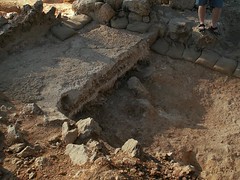
This is a closer picture of that bundle of floor layers. Do you see what is under them?

That's right. Someone found a layer of broken pottery and, rather than clean it away, someone probably just piled dirt to level it out and then built their floor above it. And the next layer went over that, and so on.

So the diggers had to carefully remove a layer at a time, knowing that eventually they would get to a huge amount of broken pots.

By the way, why do you have to go down a layer at a time? Because you can't find out when a floor was made by what's on top of it, only by what's in it or under it. If the floor stands on top of a coin from 40 BCE, then the floor could not have been built in 41 BCE.

One of the bosses explained the fallacy of looking at what's above instead of what's below. "See that stone floor? What's on top of it? A picnic table! So the floor must be from the plastic era."

Ramat Rachel 10 - On the level


Ramat Rachel floor 1
Originally uploaded by fifteeniguana
On one of our tours of the site Yuval told us that every archaeology student gets told about stratification. They are showed a diagram that shows the levels of a dig. Here is a Greek level, and above it a level from the Roman era, and on top of that is the Byzantine.

Now, look around, Yuval said. Under this one tarp you can see an Iron Age wall, a Byzantine wall, and a military trench from the 1948 War of Independence. They are all at the same level.

Good luck, archaeology students!

But at the other extreme, look at this photograph. As Terri says, it doesn't seem real, but like a drawing for that archaeology class. See the neat layers fo floor on top of floor? That is how it was found at Ramat Rachel. Now go to the next blog entry for a closeup.

Ramat Rachel 9 - A beautiful collapse


Ramat Rachel Column
Originally uploaded by fifteeniguana

“This is a beautiful collapse of a Byzantine church,” said Omer happily. We were getting the end of the week tour of the entire dig, so everyone got to see what the other groups had been doing. The reason Omer called it beautiful was that the big stones that made up the wall had fallen over so perfectly that anyone could have picked them up and put them back in place: in short, the fall was a diagram of the original wall.

Every day Oded and the other leaders selected a find of the day. Let me tell you about some of them. They were exploring a columbarium – a manmade cave whose walls were full of triangular niches for pigeons to lie in. Oded says pigeons were iron age chickens: used for eating, fertilizer, and as the smallest acceptable sacrifice at the Jerusalem temple. So, he said, if you were coming to the big city for the festival and realized you left your goat at home – don’t you hate it when that happens? – you could buy a pigeon to sacrifice instead.

One day in a bottom niche they found a small clay pot,, maybe the size of a softball. They gently removed the lid and found a cache of silver coins. That got us an article in Ha’aretz, one of the major Israeli newspapers. The dig has been getting good publicity – Oded’s phone keeps ringing, - and that has it’s good and bad sides. It brings in sponsors and other resources. It also encourages looters who think they can find “buried treasure.” (Ha’aretz probably didn’t help by calling the silver coins gold.

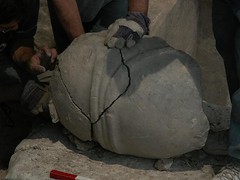
ANother cool find was a column base, or really about a quarter of the base (see photo.) Many column capitals (columns) have been found in Judah, but this is the first column base. It is about the size of a sofa ottoman and you can see the carving of a flower on the side. Someone had apparently dumped it into a hole on D1 a long time ago and it broke into several pieces. You can see several hands holding it together for the picture.

But I think the coolest thing we found was a red ball about the size of a grape, made of a half-expensive stone (okay, Oded meant “semi-precious,” but don’t you like it better his way?)

There is a hole drilled through the ball so you can hang it on a necklace. And on one surface there is a picture carved: it is a wordless seal. You put a little wax on a document, press the image onto it and you have a bulla, or seal impression, guaranteeing the official and confidential nature of a document.

Archaeologists love bulae, but seals are even better, because they are rarer and the bulla is an imperfect copy of the original.

Oded made a clay bulla and sent digital photos of seal and copy to two experts by email (incredible how much faster this stuff can happen than, say a decade ago). The experts independently offered the same tentative conclusion: the seal appeared to be from the second Parthian Empire.

Why is that cool? The Second Parthian Empire only ruled Judea for about a dozen years. That narrows down that particular level somewhat dramatically. (Okay, the seal could have been found during the empire and lost in a level 100s of years later, but you deal probabilities.)

Other finds of the day included a wall where no one expected it. But once they noticed it they found traces of the wall in several parallel holes. Yuval said: “This wall is our friend now. It follows wherever we go.”

Friday, August 15, 2008

Ramat Rachel 8 - The mysterious toothbrush


Ramat Rachel hotel 1
Originally uploaded by fifteeniguana
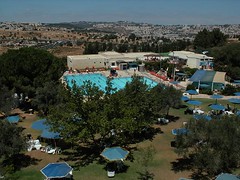
This is the view from our hotel room.

One reason we chose Ramat Rachel for our digging experience was the quarters. Many digs want the volunteers to stay in hostels or four in a room. Here the dig is next to a four star hotel, owned by the kibbutz, and we got a discount.

Well, it isn't what we would call a four star hotel. Terri called it a four star hostel. Maybe two stars in the states, maybe a bit more. But it does have the best outdoor pool in the region, a spa, and Terri was impressed by the gym, although she had to pay about eight bucks to use it.

A gym story. Terri was lifting weights and found the equipment set up for people with longer arms, which made it difficult to put the bars back safely. The attendent noticed and kindly offered to spot for her. She asked where Terri was from and explained: "Women in Israel don't lift weights. They are afraid they will get big muscles."

"Not unless they take steroids," said Terri.

The food is buffet style a thte hotel and is included in our fee. There is a lot of it and some of it is good but it is repetitive - I cheer on the rare occasions when their excellent couscous appears. The meals are fleische (meat as opposed to dairy) which brings up my big complaint.: dessert. Since they can't have milk with the meals why are desserts imitation cheesecake, imitation cream pie, imitation ice cream, dairyless pudding, etc? Why not fruit pie, cookies, nut bars, jello, or other things that need no milk? (To be fair, fruit pies showed up occasionally, but the imitation milk was a constant.)

One thing I need to say about the hotel: we forgot to ask for a smokefree room until a few days before we arrived. They managed to round one up and that was much appreciated.

On the other hand, whenever the maid cleaned our room we smelled smoke. One day we came in and the TV was on and one of the waterglasses in the bathroom contained an unfamiliar toothbrush. Now, THAT was creepy.

Inevitably some of the staff speak better English than others (They all speak it better than I speak Hebrew.) One day I called and asked that something be brought up to our room, 668. The woman at the desk assured me that they had no room 668.

Oh no? Then where did they put that toothbrush?

Ramat Rachel 7 - The pit is not the pits


Ramat Rachel Pit 4
Originally uploaded by fifteeniguana
On Friday three strong young me,(not including me) smashed the hell out of the stone with a sledge hammer and a sort of manual jackhammer ("The perfect thing for a hangover," said one of the students. There had been free beer at the end-of-week party the night before.)

That reduced the rock to about the size of a microwave oven and four strong men, (again not including me) tied ropes to it and pulled it out.

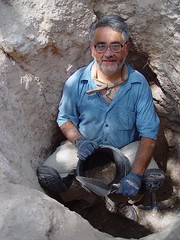
Then I got to spend a happy two hours digging down in the pit. See the photo by John Vanee. Found my first pottery handle. Bosses occasionally came by and said, in amazement "Are you still finding pottery down there?" I would toss up my latest find and keep going.

Ephrat pointed out a weird arch on one side that appeared to be different from the rest of the put. And on the next workday Felix and Tibor broke through it and found a smaller hole (room?) made of softer earth. Perhaps more will be revealed.

Ramat Rachel 6 - Sinking deeper


Ramat Rachel pit 3
Originally uploaded by fifteeniguana
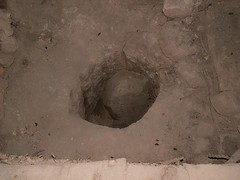
This is the pit about as deep as we could get it without getting the stone out.