Showing posts with label archaeology. Show all posts

Saturday, November 21, 2009

Digging the Middle East 2: Thieves of Baghdad


As a youngster in New York City, Matthew Bogdanos expected to go into his family's restaurant business. Then, on a whim one day, he tried to enlist in the Marines. The recruiter took one look at his test scores and said: no. He was going to enroll in college and the Marines would then be happy to accept him to the Officer's program

So Bogdanos became the first in his family to attend college. One result was that when 9/11 happened he was a prosecuting attorney in New York, as well as an Marines Reserve officer. Off he went to Afghanistan, among other places.

When the U.S. troops took Iraq and the museum in Baghdad was infamously looted, Bogdanos convinced his superiors that he - a lawyer/warrior with extensive knowledge of classical art and literature - was the perfect man to lead the team to get the stolen art back. And that is the main story of Thieves of Baghdad.

Like everything else in the Middle East, the theft was more complicated than it looked. For example, Bogdanos learned that many of the items were not really stolen. Some were taken by museum staff and others to protect them from the invading Americans. So he had to add diplomat to his job description: convincing Iraqis that the U.S. forces didn't intend to steal the relics for American museums.

The book is fascinating. I just opened at random and found this discussion between Bogdanos and a Lieutenant Colonel he liked:

"Matthew, would you like to join an experimental multiagency counterterrorism unit General Harrell is forming?"
"What is it?" I replied.
"I can't tell you. It's focal point." (meaning a security clearance above top secret, and -- like 99.99 percent of the people -- I didn't have that clearance).
"What will it do?"
"I can't tell you that either."
"You can't tell me where it'll operate either, can you?"
"Nope."
"Sounds good. I'm in."

Monday, November 16, 2009

Digging the Middle East 1: The Buried Book


Not that you asked, but I’ve decided to tell you about my (roughly) five favorite books about Middle Eastern archaeology. I’m just a buff in the field, but I recently read a terrific book and decided to blurb/blog (blurg?) about it and four other faves. In no particular order…

The Epic of Gilgamesh is one of our oldest literary masterpieces. With its themes of quests for immortality and concerns about the proper way to live as a king (or a person) it is still fascinating.

It is easy to forget that the Epic was lost to memory for millennium. David Damrosch has constructed his The Buried Book, as he notes, like an archaeological dig. It begins with the most recent layer, and moves farther back in time.

The first chapter is about George Smith, an Englishmen with a unique ability to translate ancient texts. A printer by trade, he used to visit the British Museum on his lunch hours, and contrary to the stereotype of Victorian England, the scholars recognized this lower class tradesman for the find he was. He was able to bring the ancient tale of Gilgamesh into modern language and, in 1872, discovered one of its most greatest attractions: a story of the world flood with unmistakeable parallels to the one in Genesis.

Next Damrosch tells the story of Hormuzd Rassam who discovered the texts but was cheated of some of his fame because of English prejudice against foreigners – surely he was no more than the hired digmaster, working for some proper British supervisor!

The book then covers what we know about the writing of the Epic, which is rather surprisingly much – even including the name of the scribe who is credited with putting the final version together. Even more amazingly, while we only have two thirds of the text of this final work, we have some of the Sumerian poems from which the Assyrian version was compiled – which is as if we had some of the early texts Homer had used to compose the Illiad.

Finally Damrosch shows us what can be glimpsed through the veils of time about the historic person Gilgamesh – or more properly Bilgamesh. Take this little tidbit. One ancient scribe compiled a list of all the kings who had ruled in Sumeria. His collection of the monarchs of the city of Uruk can be divided into recent historical figures (with reigns from 6 years to a few decades) and ancient mythical figures (who supposedly ruled for thousands of years each).

These two groups are neatly separated by a king who supposedly ruled for 126 years. I don’t think you need to be a scholar to speculate: “this one isn’t completely a myth. They knew something about him but he was so legendary that they had to credit him with a century of rule to account for everything he supposedly accomplished.” As you may have guessed, that king was Bilgamesh.

The Buried Book is great fun.

Friday, August 15, 2008

Ramat Rachel 6 - Sinking deeper


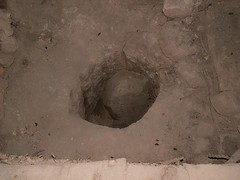
Ramat Rachel pit 3
Originally uploaded by fifteeniguana
This is the pit about as deep as we could get it without getting the stone out.

Thursday, August 14, 2008

Ramat Rachel 4 - I must be a volunteer, because you couldn't pay me to do this


Ramat Rachel Aharoni
Originally uploaded by fifteeniguana
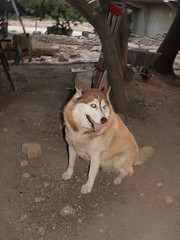
This dog hung around the site so we named him Aharoni. Presumably the spirit of the original excavator was keeping an eye on us.

A bit of archaeology jargon: the diggers don’t refer to a year, but to a season. The 2008 season at Ramat Rachel is four weeks long: twenty working days. We are never allowed to forget that every day a precious 5% of the season is disappearing and we have to make the most of it.

Sometimes it doesn’t seem to work out that way.

I worked on Site D1, one of about eight active spots. Lisa, a smart, funny German woman was in charge, assisted by Ephrat, a quieter, younger Israeli, who was raised on Kibbutz Ramat Rachel, five minutes from here). About a dozen volunteers worked on D1 in a big rectangle surrounded by sandbags. Some parts were already several three or four meters deep and have revealed stone walls, an olive (or wine) press, and so on.

On the first Friday Lisa decided to open a new section. That meant using pickaxes to chop open the surface, filling sandbags to mark the edge, and hauling away the rest of the dirt by the bucket and wheelbarrow load until you see something the bosses think is interesting.

The problem is that this area was hardpan, dirt tough as cement. After an hour or so of our slaving away at this Lisa reassigned us. A bulldozer would come on Monday, she assured us, and do the awful work of cutting through the rocklike top layers.

Fair enough. But on Monday no bulldozer appeared. Oded, the Boss Boss Boss, explained cheerfully that all the Arab bulldozer drivers were being examined “to see if they were crazy.” Last week, for the second time this year, an Arab from East Jerusalem had driven his bulldozer into traffic and tried to kill people with it. (This happened the day that Obama arrived in Jerusalem.)

So, since there was no bulldozer, Lisa and Oded decided that Feliz, John, Rachel, Konni and I could be a bulldozer. We worked from 5:30 till 1 that day using pickaxes on soil we had been told a machine could remove much better. (On Friday one of the bosses had joked that they might not bother with a ‘dozer because “fuel is expensive and food is cheap.” It wasn’t so amusing now.)

At the end of the day moral was low, blisters were high, and my lower back hurt (repeat after me, everyone: lift buckets of dirt with your knees, not your back). Lisa called us together and said it would probably be two or three days before the machine was available and did we want to keep going the next day or be reassigned?

Everyone voted for the latter. When it was my turn to speak I said “I want to be productive. If you say a bulldozer can do this better than me then give me something else to do and let the machine do it.”

“Wisely spoken,” said one of the German students.

But we still need to talk about the pottery from that awful Monday. Archaeoloists love pottery because they can use it to determine the date of a site (9th century pottery doesn’t look like 8th century, to an expert), and maybe where it was made. For obvious reasons, pottery found near the surface doesn’t tend to be very useful. It could have been picked up anywhere and trod underfoot anytime in the last few hundred years.

However, we stalwart diggers did find a few nice sherds during that grueling, backbreaking Monday, including a couple of pieces of rim and handle, which are especially useful. When we were cleaning up I gave the specimen bucket to Ephrat who showed it to Lisa. Lisa looked at the top two or three pieces, and shook her head. Ephrat then dumped our day’s finds into the rubbish bin.

To paraphrase the Terry Pratchett novel I am reading, that took the cake, the candle and the biscuit with sprinkles on top. Monday was a very bad day. Oded later admitted that using us as a bulldozer was “our mistake.”

The next day things looked up, as I started sinking into a pit.

Ramat Rachel: 3 - Get with the schedule


Ramat Rachel: Rob
Originally uploaded by fifteeniguana
That photo (by fellow volunteer John Vanee) may appear to be Indiana Jones contemplating his latest great discovery, but it is actually me on popsicle break. I think I was trying to decide between cherry and grape. Here is a summary of a day on the dig...

The alarm goes off at 4:15 and you think it's a mistake or a crime against humanity, but you struggle out of bed and try to make yourself
presentable. Then you check that your backpack contains: kneepads, hat, workgloves, sunglasses, camera, water bottle, sunscreen, and cell phone. All set? Good.

At 4:45 you head down to the hotel lobby. In the coffee bar they have set up cereal, tea, milk and something resembling pound cake. Not a very inspiring breakfast, so you are lucky you cribbed some pears from last night's dinner.

The volunteers (100 of them) and staff (perhaps 20?) slowly trickle in and suck up caffeine. At 5:15 you take the five minute walk past the beautiful hotel swimming pool to the archaeological park. By 5:30 your group is collecting tools - pickaxes, hoes, brushes,and wheelbarrows - from the locked containers and starting to work.

It is barely light enough to see but it will be in a few minutes. The
section boss tells you what you will be doing that day. The next three
and a half hours are the most productive part of the day, because it is
delightfully cool and everyone is fresh.

At 9 AM somebody shouts "Breakfast!" We drop everything
and walk (across foot-narrow stone walls in some places) to the potwashing area, which is covered by a huge tarp. Here everyone sits down for the best meal of the day.

In most Israeli restaurants and certainly any big hotel the food is kosher so every meal is either dairy or meat (or parve, neutral,,, but that's unlikely.) Fish is bi, and shellfish , like pork, is taboo.

Breakfast is milche - dairy. This morning I had scrambled eggs, a cheese pastry, sliced peppers, a crisp roll to which I added tuna fish and cheese,watermelon, a yogurt, and tea. Not bad.

After breakfast you go back to work until eleven-thirty when we have fruit break, at our worksites. Today it was plums and popcicles. Then you work until 1 PM when you carry the buckets of pottery sherds back to the big site Then, for a change, you get to wash a bucket of yesterday's pottery which has been soaking in water overnight. By 2 PM you get to go back to the hotel and - the schedule insists - SHOWER before lunch. Trust me, you need the shower.

After lunch your time is your own until 5 or 6 PM when there is a lecture or other event, depending upon the day. (Imagine meeting archaeologists you have been reading about for twenty years and struggling to stay awake during a fascinating lecture, because it has been a LONG day.) Dinner at 7, and then if you are
smart (or at least middleaged) you tumble into bed and wait for the alarm to start the whole cycle over.

Ramat Rachel 2 - Everything you know is wrong


Ramat Rachel
Originally uploaded by fifteeniguana
As I said, Yohanan Aharoni was the first archaeologist to dig here, back in the fifties. He thought he had found an Iron Age palace belonging to Hezekiah, king of Judah around 700 bc. Problem with that logic is who builds a palace three miles from their main palace?

Oded Lipschits is running the dig now and he has a different theory. Let me exlain the layout and see if you come to the same conclusion.

What we have here is a palace (or palatial buliding, anyway), a citadel (small fort) in front of itm and in front of that something unique in Judah: imported brown topsoil with water fountains and paths: a planned garden.

So, around 700 bce, the time Judah became a vassal state of Assyria, this impressive building went up three miles from, Jerusalem the capital. It looked down on the capital, and on major trade routes. It cotinued to be occupied as Judah was taken over by the Babylonians, the Persians and the Greeks. Then the Hasmonean era began and Judah was free (think of the
Maccabees and Chanukah) and the Ramat Rachel palace was destroyed by fire.

Do you see it? Oded thinks (if I understood him ocrrectly) that this wasn't a Judahite palace. It was the adminsitrative office of the occupying power, close enough to the capital to keep an eye
on it, but not in-their-faces where it would draw trouble. And as soon as they Jews liberated their country they destroyed the
occupier's palace.

Anyway, that's Oded's theory at the moment. The interesting thing about archaeology is that tomorrow's dig may change it all.

For example, on the first day they gave us a tour of the site, telling us what they thought was going on each each area (there are about eight active sites this year's season). On Thursday night we repeated the tour for a review of the week, and at one
site everything they thought they knew had been overturned in four days work.

As I understand it they were expecting to find an extension of that garden. Instead they found a trench, maybe three meters deep, five meters wide and well, after establishing that it went at least fifty meters long they stopped for a think. The photo above shows Oded at the end of the trench.

Almost certainly it is the foundation trench for an outer walll, but no
one expected to find a wall there at all. Hmm...

Ramat Rachel 1 - Digging Israel


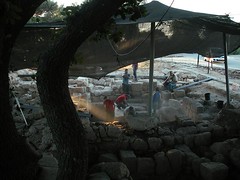
Ramat Rachel Site D1
Originally uploaded by fifteeniguana
My wife Terri and I just spent two weeks volunteering at an archaeological dig at Ramat Rachel Israel. I am going to put up several blog entries describing the experience, so be warned.

Ramat Rachel is about halfway between Jerusalem and Bethlehem, less than three miles from each. It is so close to the political (but not geographical) West Bank that during the 1950s several archaeologists were killed by Jordanian border guards.

The name is modern, coming from the kibbutz. During the 1940s the kibbutz decided to build a water tower on the hill. That's when they discovered the ruins. Yohanon Aharoni was the first excavator and he discovered ruins from the Iron Age (circa 700 BCE) to the Early Muslim era (say 1000 CE).

The current dig is co-sponsored by the University of Tel Aviv and the University of Heidelberg. Oded Lipschits is the archaeologist in charge, alias the Boss Boss Boss.

The photo above shows an early morning at D1, the section of the site where I was working (click on it for more detail). Oded is the gentleman in the middle with the camera. If you are interested, read along and you will learn a lot more about the experience.
By the way, Keren, a volunteer with much more energy than me actually live blogged throughout the four weeks of the dig. Read it (with plenty of pix) here.